

What does it mean to be a workaholic? Is it when you willing or happily and regularly work more than 40 hours a week (full-time in the USA)? Is it when you don’t go on vacations, don’t meet up with friends or family? Is it when you obsessively check your phone or work email outside of regular work hours?
For me, I’d say you’re a workaholic if you do any of the above. I may even call you a workaholic if you volunteer for extra duties at work, without compensation or to avoid something worse.
I’m not a huge fan of working. I like the money it gives me. I get to travel. But if you told me I’d have all the money I need for the rest of my life, I would happily never work another day in my life.
Now, for the important question – Can a country be workaholic?
Holiday Make-up
I’ve recently talked about how I celebrated Mid-Autumn Festival and about how much fun I had. What I didn’t mention was that most people had to work on their weekends to “make up” the missed work.
And it’s not just a few companies that are worried about “lost productivity” or something else ridiculous. It’s everyone! Adults at work. Children in schools. Even the government! There are even “official make-up days” that are published along with the holidays on calendars.
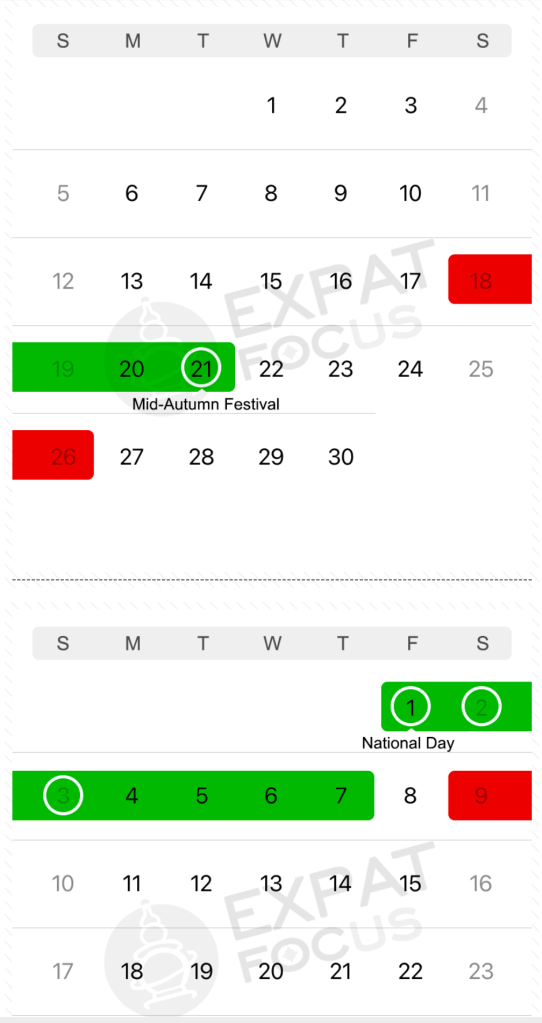
It’s not really even extra time off. For Mid-Autumn Festival, a 3-day weekend, people worked the Saturday before and got Sunday, Monday, and Tuesday off. I’m not really sure that’s a fair trade. Yes, you get three days off instead of the normal two, but you had to work 6 days in a row to get it. You just shifted the days around a little.
For National Week, where you get a full week off, October 1-7, most people had to make up a Sunday before and a Saturday after the holiday break, but you do come out ahead with this holiday. You get actual time off as there are 3 days off work, not made-up, mandated by the government.
Now, none of that was my experience. I work at a training center, so they do everything differently.
I have some holidays that are days off according to my contract, usually just those mandated by the government. But it means that I’m entitled to one day off for Mid-Autumn Festival and 3 for National Week.
However, I didn’t get any days off for Mid-Autumn Festival. It fell on a Tuesday, my normal weekend, so work conveniently “forgot” to give us a day off. They are going to pay us for working an extra day, but I would have rather had the day off. I could have tried to go on a little weekend getaway (Yes, I don’t seem to have learned from what happened in Xining after I visited Zhangjiajie).
For National Week, I am getting my 3 days off and it’s being combined with a weekend. So, I have 5 whole days where I don’t have to go to work. Finally! A holiday! And because they are only giving me the days required by my contract, I don’t have to make anything up!
Some of you that are good at math may have gone, “Wait, everyone else is getting 2 more days of holiday than you. Are kids really going to be showing up for classes on their breaks?” And the answer is probably not.
My Chinese teacher has decided to cancel our classes for the 6th, the first day I should be back, and add them to whatever I teach on the 7th.
It’s going to be a long day.
996
Now, on to things that don’t personally affect me. China’s 996 work culture.
According to Chinese labor laws, a normal workday is 8 hours or 44 hours a week. There is even a limit on how much overtime someone is allowed to work – 36 hours a month! Which, if my math is right, means that people are only allowed to work 53 hours a week, on average. By law!
However, this has not been well enforced as in many of the country’s big companies employees often work far longer hours and are not always compensated
Shawn Lim, The Drum
996 refers to working from 9 to 9, 6 days a week. Usually, it is the tech companies that favor this work schedule, but I’m sure there are other places that also use it.
People regularly work over 300 hours a month. People have died from working a 996 schedule.
Also, a lot of the companies that have 996 schedules, don’t pay their employees for the overtime, coerce them into working it, and don’t believe in a work-life balance (probably never even heard of having a life outside work).
The government has recently started to notice and crackdown (yes, another crackdown) on the practice. The government wants women to have more children and having a stressful and all-consuming work environment is not conducive to procreation.
Me, Me, Me
I know I complain a lot about work, but I, personally, like to complain. I don’t usually want anything to change and know that I can’t change anything anyway. I also know that I have it good. And I don’t work that much, outside of actually teaching my classes.
The Chinese teachers at my training center have it worse. They all work more than the foreign teachers do, but they aren’t quite working 996. They do work 6 days a week, but they are not 12 hour days. Most workdays, they only work a couple more hours than I do.
Granted, they are usually harder at work than I am. And the students’ parents can contact them whenever they want.
So, do you think China could be considered workaholic?
What are some unusual labor practices you have seen?


 My TEFL Adventure
Also in Korea and Japan similar situation. But it’s getting better. Some companies shut down electricity after 6 pm to protect employees from overworking
LikeLiked by 1 person
That’s one way to prevent people from working!
LikeLiked by 1 person
Different work ethic from Australia but things are changing here. Growing casualisation of the workforce and contracts that involve unpaid overtime. It is Create the China preference people from working too much overtime.
Why did they want women to have more children? I thought population control was important to the government.
LikeLiked by 1 person
In America, internships are a big problem with having unpaid work, but many companies are considering work/life balance, if they want to keep their employees happy and working.
But, in China, there are so many people that the jobs still have their pick of candidates.
Population control was, but it worked a bit too well. People are allowed up to 3 kids, but few want more than one. People are only averaging 1.3 kids. They are saying the population will halve by 2050 or so.
LikeLiked by 1 person
Wow! That is amazing that the control measures worked so well. The government must be concerned.
LikeLiked by 1 person
Very. It’s why they are cracking down on training centers to reduce the cost of raising kids.
LikeLiked by 1 person