

In America, I have taken classes to learn Spanish, Japanese, Italian, and Chinese. I learned Spanish and Japanese in school and Italian and Chinese as an adult. I never went to an after-school language program while I was a child, like the kids I teach do.
I had to do assignments, quizzes, and tests for the languages I learned in school, just like in all my other classes. However, there were no assignments or assessments in my Italian class. You moved to the next level when you finished your current one, if you wanted to.
When looking for a Chinese school, I wanted something that had homework, exams, and taught the characters. My classes did have homework, usually the exercises in the book. The teachers did write characters, but they also wrote everything in Pinyin (using this alphabet). One of my classes did do some exams, but they really didn’t count for anything, but to see what you knew. The tests were also mostly writing tests (write the character or write a sentence), with the occasional fill-in-the-blank.
However, at my training center, the older kids get graded often and take vocabulary tests (the teacher says the word and students have to write it, use it in a sentence, and/or write the definition) in many classes. They also get graded on any workbook activity they do. The only thing that doesn’t get a grade is their writing, but it does get corrected. (So much red everywhere!)
The younger ones only get a midterm and final exam as they don’t write and classes are supposed to be more fun than serious, hard work. Most of the older ones also get their versions of these tests, but it’s not their only grades like it is for the younger ones.
My beginner classes had their midterms in May. It was my first time giving them a test!
I was given all the testing materials and some English instructions when I started and was allowed to make changes, if I wanted, but the only thing I changed was an accordion, as that wasn’t a word they learned and I had no idea why it was even there.
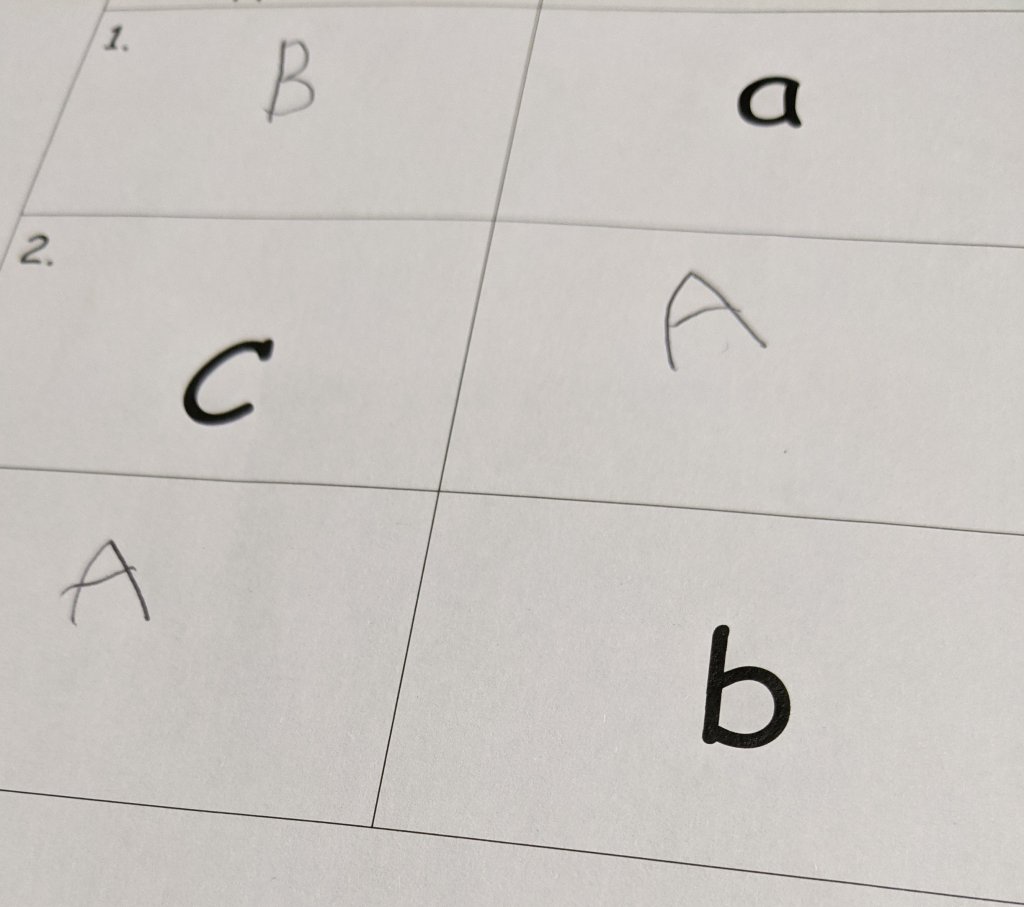
The test consisted of me asking them some basic questions, like what’s your name, that they could answer on their own, some harder questions, like what can you do, that had pictures for them to look at and tell me the answer, some pictures of their vocabulary words, and reading and writing the letters A, B, C.
All things that they had been learning and practicing for about 2 months now. Most of them do well in class, but if one kid knows the answer, the whole class does. This would be the first time they won’t have their classmates to help them.
I spent most of the first half of class reviewing what is on the test, but if they don’t know it by now, I doubt they’ll learn it in half an hour.
Then, my Chinese teacher set up her phone to video the exams (they are almost completely oral) in another room where I’ll go with the individual students to have them take the test.
Most of the kids are confused, especially at first since it is our first time doing this, but they quickly relax and realize that they know most, if not all, the answers. It was all the same questions as in class.
It was really fun to see how much the kids know already! One said he can draw with his grandpa and I never taught them with. Another one’s pronunciation is nearly perfect, when most kids leave off final sounds for many of the words.
On the other hand, a lot of the kids had issues with some of the newer sentences, especially the longer ones (anything over 3 words). They also had a lot of issues with the letter names. Mostly they could write the letters, even if they didn’t know the names. Mostly.
As much fun as it was to not have to entertain the class for 40 minutes, I did have to do a write-up on all of the students since they didn’t have a paper test, like the older students who can read and write. Luckily for me, I took notes and recorded all the students. I just have to get the videos from my Chinese teacher.
After spending an hour writing up how the kids did with the sentences, pronunciation, vocabulary, letter identification, and letter writing in the electric form of my note sheet, I also filled out a rubric for the students based on how well they did.
It is much more work than for an older kids’ mid-term exam. I’ve had to give a few in make-up classes. Their test is 6 pages! And includes fill in the blank, write sentences, grammar, reading comprehension, and writing. I just give them the pages and they get to work.
Their final, which I also got a while ago but haven’t really looked at it too closely, is basically the same format as the mid-term. Some answering questions, some identify the picture, some identify and write the letters. I’m assuming that the process will be the same, too. One kid at a time with a phone to record how well the kids do.
I can’t wait for their finals! They’ll know so much more by then. And the exams are a nice break for the teacher (I do much less work in these classes than in a regular lesson).
But if, as an adult, I could go to a language school like this one, I’d jump at the chance. And hate every test, writing activity, and homework assignment. But I’d learn so much more than I did in my other languages classes and be more likely to remember it years later.
If you have any questions about any of the terms I’ve used, look in the glossary.


 My TEFL Adventure